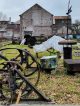

Little backstory. I used to live close to the Constantin Meunier Museum for around four years and I had never had the chance to visit it, even though it was a 5-minute walking distance. It is always like that when something feels so handy that you always procrastinate because “I can go whenever I want”. Then you never go, and you even move to another commune, on the opposite side of the city. Chances to visit it seem even less. Flash-forward. I am reading at the Botanique garden, the closest public garden in my new neighbourhood, I am spacing out after reading something poignant, and my sight falls at some of the sculptures that decorates the top of the stairs, in front of the rotonde.

Dear Theo, in all his works, Meunier is far superior to me. (…) He painted the metalworkers of the Borinage and their procession on their way to the mine or the factories. (…) He painted all those things I have always dreamt of being able to do.
Letter of Vincent Van Gogh to his brother Théo, 1889
Most of the time, busy with our lives, we overlook and neglect signs and symbols that the city, in its long history, has piled up. It is not like the Rosetta stone that we need to decipher to understand hieroglyphics, but these signs and symbols may help us establishing a more meaningful relationship with the city, the country, and its history. So, I was looking at one statue particularly, which had a very similar posture as mine. I was reflecting on the things I had just read; I would later find out that the statue was le Moissonneur (The Harvester) and the worker seemed to be resting for some time, also thinking and looking on how much work remained to do. I was intrigued by this correspondence, and I searched who the artist was, and indeed was Constantin Meunier. I took this little serendipity event as a motive to finally make up my mind and visit the museum.


The area is more known for having a quite high concentration of contemporary art galleries, Xavier Hufkens, Almine Rech, Felix Frachon, Meessen, just to name a few; but already at the end of 1800’s it was populated by many (mostly rich) Belgian artists such as Thèo Van Rysselberghe, Henry Cassiers, Isidore Verheyden. In one of these an eclectic façade, combining red bricks and courses of blue stone, hosts the Constantin Meunier house-atelier, built at the end of XIX century by Ernest Delune, one of the most famous art-nouveau architects, where the sculptor will spend the last years of his life tirelessly dedicated to his work; it became a museum in 1936 and in 1978 was annexed to the Royal Museums of Fine Arts of Belgium.
The feeling we have when inside is not the same as when visiting other museums, not necessarily bigger ones. It comes to my mind the Charlier Museum (here the first instalment of this column about it), which was also the former house of the sculptor Charlier. There you are immediately brought back to a time when that house swarmed with intellectuals, musicians, and literary figures. You can almost perceive the music, the conversation and in general the glamorous atmosphere. Entering the Meunier Museum is rather the opposite experience, a secluded, deeply personal, and minimalist ambience (especially in the first rooms), where Meunier’s spirit is palpable, given his near-total dedication to his work, a dedication shared by the rest of the family, as some photos seem to suggest.Certainly, the museum has changed in the course of time: from its inauguration by king Leopold III in 1939, when every square meter of the walls was covered with paintings and drawings, and the sculpture are dotted around the rooms, to the restoration works in the ‘80s when a more sober display gets rid of the horror vacui so that the artworks can breathe. Since then, the museum has not undergone any major changes, and as museological standards evolve, we can say, without fear of being refuted, that the museum is not up to date. Nonetheless, the aim of this column is not to argue about museum standards, museography and such; the purpose is to show how even intertwined are museums, even the small ones, with the story of the city which ultimately is ours too.


“Then chance led me to the Black Country, the industrial land.
Constantin Meunier, 1881
I was struck by its tragic and untamed beauty. I felt within me the revelation of a life’s work to be created. A great sense of pity came over me”.
I have selected only three works from the collection to highlight, that personally meant something to me, and it is a sort of invitation to you to personally discover the rest of the museum.
Une hiercheuse (The Coal Bearer), 1887
When we think of Meunier’s works the first images that come to mind are these workers, miners, farmers etc. All of them dignified in Greco-Roman poses, bearing the hallmarks of the harsh working conditions but with pride, with the vigorousness and the strengths that become moral virtues. What contemporary viewers might not know is that mining work wasn’t solely the domain of men, also women and, unfortunately, children played an important role in it; this painting for instance shows a young woman, in a rather gloomy atmosphere, leaning on a shovel, taking a break from her hard work. Compared to the bronzes, the paintings have a decidedly less triumphal character; they are rather subdued and, in some ways, claustrophobic.
Vieux cheval de mine (Old Pit Pony), 1890
This bronze really touched me and shows the artist’s great sensibility not only towards the condition of human beings but also towards animals. Even though the piece is deprived of any further context (like in the paintings) we can still understand and almost feel at a glance the pain and the burden of this malnourished pony. Forget the idealization of hard work, the sense of pride and belonging that are palpable in the major bronzes, here we see who’s really at the who is on the lowest rung of the system.
Le Grisou, (The Firedamp) 1889
My first encounter with Meunier’s work was at the Fine Arts Museum of Belgium when I saw the work Le Grisou, a very dramatic sculptural group of which two versions of it exists, a monumental one in bronze located on the central hall of the Fine Arts Museum, and a smaller statuette present in the Meunier Museum. It shows a specific moment in the aftermath of a disastrous explosion in the mine of La Boule, in Quaregnon where 113 bodies of miners were brought to the surface. The artist was present and was struck by an old woman looking for her son among all the dead bodies. The mother-son reunion gives life to this moving scene, a proletarian pietà, lacking any kind of hope in a redemption in the afterlife. This work strongly resonated with me because the history of Sicily, my home region, has been affected by similar events in the sulphur mines. In Sicily it has been less a theme for visual artists like Meunier and more of writers, one of them being Leonardo Sciascia who wrote a short story called “L’antimonio”(The Antimony) which was the term used in Sicily for the grisou (firedamp); the only thing was my great fear of antimony, because it had burned my father in the same mine. It was a mine which, according to the memories of the oldest, the owners had always exploited without caring about the workers’ safety; “accidents” were frequent — a roof caving in or an explosion of antimony. And the families of those who had been crushed or burned took it as destiny (from Sicilian Uncles, Paladin).
Opening Hours:
Tuesdays – Fridays: 10:00-12:00 and 12:45-17:00
Saturdays – Sundays: only for groups with booking and museum guide
More info: Meunier museum website